

Bob is not an idiot. In fact, if you ask him, he’s probably the smartest guy in poker. While others spend hours grinding solvers, analyzing hand histories, and building data-driven strategies, Bob has cracked the code. “It’s simple,” he says. “Always apply pressure.”
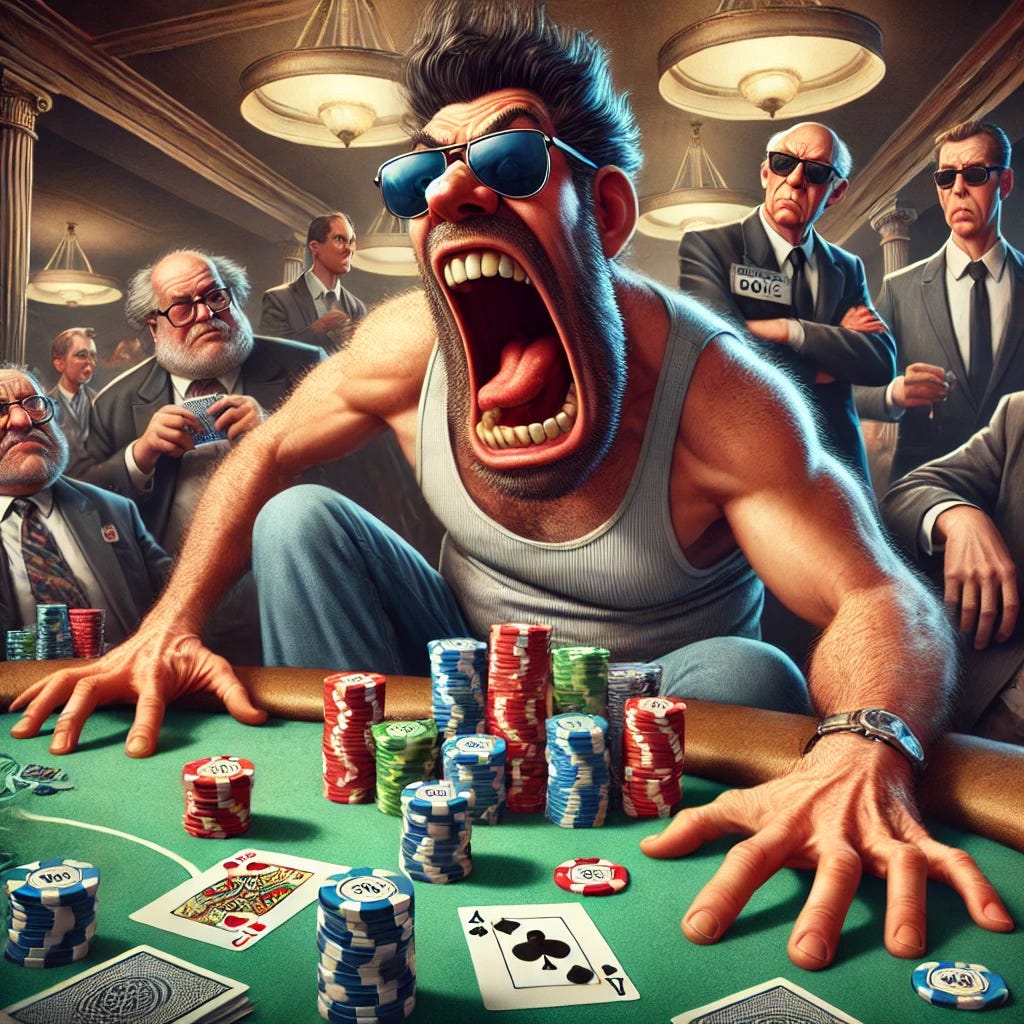
Bob’s belief system wasn’t born out of pure ignorance—it started with a hot run. Bob thinks he’s a street brawler, where swinging wildly and intimidating the other guy wins. But what Bob doesn’t understand is that poker isn’t a brawl—it’s a special forces operation. But what he doesn’t realize is that it’s actually a sniper duel, where precision, preparation, and choosing the right moment to strike matter more than raw aggression. The real killers aren’t just the ones who fight hard; they fight smart. No international arms treaty can ban preparation, discipline, or raw brainpower—these are the weapons that truly matter in high-stakes poker. They prepare, they execute with precision, and they adapt on the fly. Just like an elite soldier, a top poker player must:
Gather intel (study player tendencies and table dynamics)
Plan for contingencies (adjust to different tournament structures and stack sizes)
Execute with discipline (making +EV decisions rather than emotional plays)
Stay calm under fire (handling deep runs and downswings without tilting)
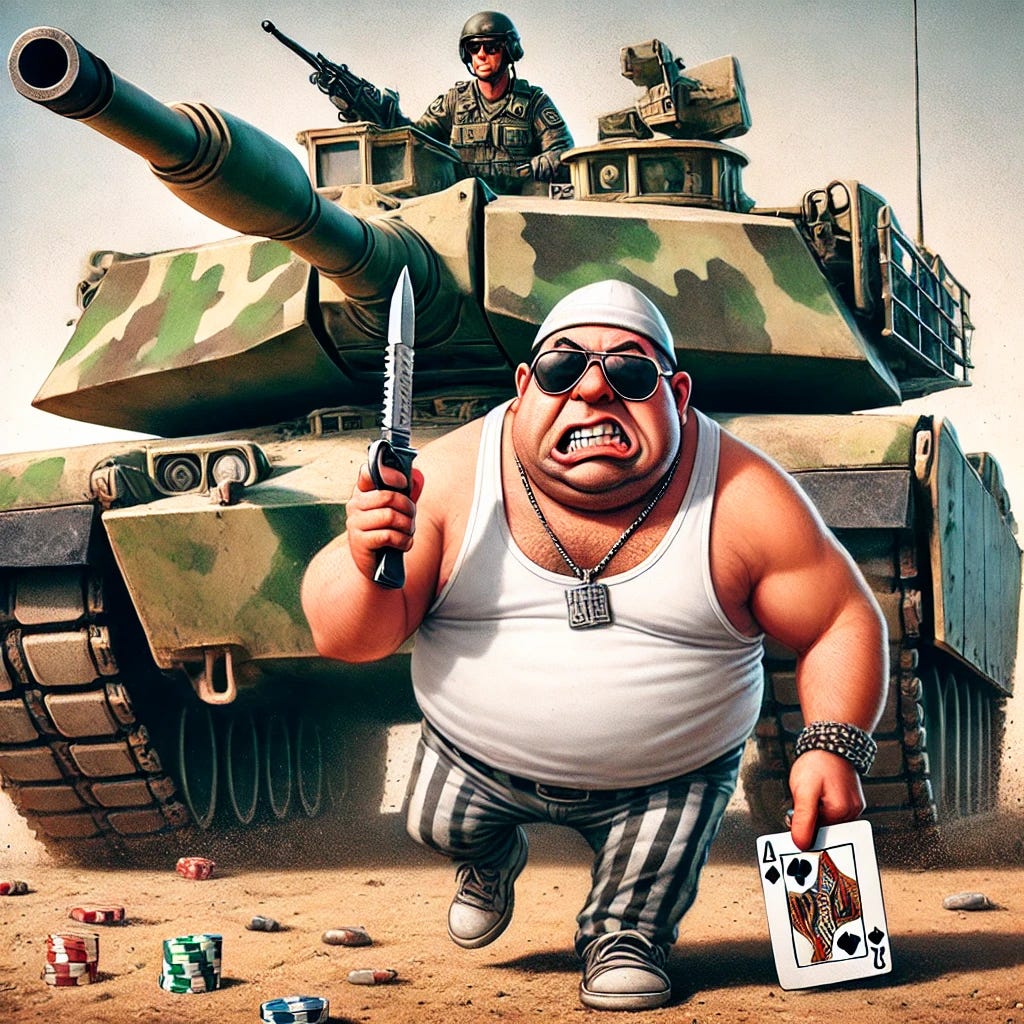
Bob, on the other hand, is the equivalent of a guy running into battle shirtless, swinging a rusty machete, convinced that pure heart and courage will win the war. They prepare for the fight by studying, training, and knowing exactly which weapon to use in every scenario. He binked a big tournament early in his career, and instead of attributing it to variance, he saw it as proof that he had the secret sauce. He didn’t need solvers; he didn’t need study. He had instincts, and instincts trump math. In his mind, poker is a game of survival where the best way to win is to force mistakes.
He says this with the confidence of a man who’s seen the future. He doesn't need your spreadsheets. He doesn't need your simulations. The game, in his mind, has been solved with the same intellectual rigor that a child applies to Connect Four. Bob’s worldview is refreshingly elegant: poker is about aggression. People are scared money in tournaments, and if you apply relentless pressure, you control the game. Simple. Efficient. Genius.
Bob, of course, has no long-term graph. He doesn't believe in sample size. He doesn’t track his results beyond the occasional score that confirms his brilliance. He will, however, tell you all about the time he bullied a "nerd" with a heroic queen-ten offsuit shove. What you won't hear about are the thousands of times Bob didn’t get there. Those, conveniently, were just “bad luck.”
The Gametree and the High-Frequency Nodes Bob Will Never See
Every poker hand can be modeled as a directed acyclic graph (DAG). Each decision point (fold, call, raise, bet sizing) is a node, and the edges between them represent the available actions that lead to new game states. The game is always moving forward—decisions lead to new situations, but they never loop back.
This game tree is vast, but not all nodes are equal. Some paths in the DAG occur far more frequently than others, forming what we call high-frequency nodes. These are the decision points that matter the most—the ones that players consistently encounter across thousands of tournaments. The most efficient way to improve is not to study every possible branch of the tree, but to run a search on the frequency of each node and focus on optimizing the bulk of decisions that actually impact profitability.
Unlike Bob, the best players don’t attempt to memorize the entire game tree. They don’t brute-force solutions for every imaginable hand. Instead, they combine solid game theory fundamentals with high-frequency node analysis—studying the spots that actually happen and matter the most.
Bob, of course, finds this ridiculous. “All that work just to play the same spots over and over?” he scoffs. “Why not just pressure them until they fold?”
Bob does not understand that every winning player is a Dreammachine, designed to print EV by making one slightly better decision at a time, over and over, across an infinite number of games. The best players come equipped for battle—they don’t just rely on brute force. They analyze the field, choose their weapons wisely, and execute with precision, ensuring that they are the ones dictating the fight. He does not see that poker is not about being aggressive for aggression’s sake, but about knowing when aggression is profitable. Bob doesn’t want to do the work because Bob believes in the power of pressure. Bob believes in his gut. Bob believes in short-term variance while ignoring long-term reality. Bob is not just wrong; Bob is fragile.
Bob and the Religion of Results-Oriented Thinking
Bob prays at the altar of results. He doesn’t believe in the game tree because, in his world, past results are all that matters. If he made a bad play and won, it was brilliant. If he made a good play and lost, it was a mistake. This thinking is the intellectual equivalent of an ancient tribe sacrificing a goat to the gods and believing it caused the rain.
Meanwhile, the real winners—the ones Bob mocks—are doing something different. They are breaking the game into data. They are identifying high-frequency nodes. They are reducing uncertainty not by making wild guesses, but by systematically eliminating bad decisions. They are making poker less of a gamble, not more. They are, in every sense, the antifragile players who get stronger with every tournament, while Bob’s fate is sealed in the long run.
Bob’s Inevitable End
Bob will not change. He still thinks he’s in a bar fight, throwing haymakers, while the real competitors are executing calculated, well-planned missions like a special forces unit, choosing their battles wisely and striking with precision. He refuses to upgrade his approach while the real professionals use the right weapons for the right battles. Bob will continue playing the same way. He will occasionally bink a tournament and announce to the world that he has solved poker. Then he will go on a 500-game downswing and quietly blame it on bad luck. Eventually, Bob will quit, convinced that poker has become "rigged" or "too tough" or "just a luck game now." The reality, of course, is that Bob never stood a chance. He was playing the wrong game all along.
Poker is not about blind aggression. It is about making better decisions, in the spots that matter, again and again, over a long enough sample. The winners are not those who blindly apply aggression, but those who relentlessly pursue excellence—studying, adapting, and refining their decisions with precision. They understand *why* and *when* aggression works, and they execute it with purpose. Bob, unfortunately, will never understand this. And so, in the grand scheme of the game tree, Bob is not on a high-frequency node. Bob is a dead branch.
Don't be like Bob. In poker, as in any battle, preparation and the right strategy win the war. Bring the right weapon for the fight—study, refine your decision-making, and adapt. No external force can take away the advantage of preparation and strategic thinking; those who master these skills will always have the upper hand. Get off the dead branch and start making the right decisions. Also, remember that the high-frequency nodes you focus on will change based on the tournaments you choose to play—whether it's turbos, hypers, or deeper-structured games. You have control over the type of decisions you will face most often, so choose wisely.